
Before We Had Words: How Movement Reconnects Us to Our Human Nature
Rediscovering the ancient relationship between movement, emotional expression, community, and the sacred.
There is a moment when a song begins, your body recognizes the rhythm, and something inside you wants to move.
Maybe your shoulders begin to sway. Your feet find the beat. Your chest opens, your hips soften, and for a moment, you stop thinking about how you look. You simply feel.
In that moment, movement becomes something more than physical exercise. It becomes expression. Connection. Play. A reminder that you are alive.
At Nawi, we see movement as one of the many ways we can reconnect with ourselves, each other, and the world around us. Long before movement became something to optimize at the gym or perform for an audience, people across cultures used the body to celebrate, grieve, pray, tell stories, mark transitions, and strengthen community bonds.
What if returning to movement could help us recover something that modern life has taught us to suppress?
What if we allowed the body to speak again?
Movement Is Part of Our Human Story
Human beings are moving creatures. Our bodies evolved to walk, reach, carry, climb, play, gesture, and coordinate with others. Movement is fundamental to how we explore our environment, communicate, and experience the world.
Dance and rhythmic movement have also held important roles in human communities across history. Although we cannot reconstruct every practice of our distant ancestors, historical and anthropological records reveal how movement has been woven into social, spiritual, and communal life across many cultures.
Consider the many forms movement can take: communal dances that celebrate harvests and seasonal transitions, rhythmic movement accompanying music and storytelling, ceremonial dances that honor ancestors or deities, and collective movement marking birth, coming of age, marriage, grief, and death.
These practices have never been identical. Every community has its own histories, meanings, and traditions. Yet they offer a powerful reminder that movement can serve purposes far beyond physical fitness.
It can help us participate in something larger than ourselves.
Through rhythm, gesture, repetition, and shared attention, movement can create a sense of belonging. It can give form to emotions that are difficult to articulate. It can help a community express what matters to it, remember its stories, and experience connection through the body.
In many traditions, dance is not separate from spirituality. It is a way of participating in the sacred: honoring the land, communicating with the divine, celebrating life's cycles, or embodying stories about the relationship between humans and the cosmos.
We do not need to romanticize the past to recognize what these practices illuminate. Human beings have long found meaning through the body, and movement remains a powerful way to experience ourselves as more than isolated minds navigating the demands of daily life.
When Life Becomes Something We Manage Instead of Experience
Modern life often rewards us for remaining productive, composed, and in control.
We spend hours sitting in front of screens, moving between tasks, monitoring notifications, and measuring our worth through achievement. We learn to prioritize efficiency over exploration, performance over expression, and productivity over rest.
Even movement can become another task to complete: a workout to optimize, calories to burn, or an appearance to maintain.
Meanwhile, the body may be carrying the effects of prolonged stress. We may notice tight shoulders, a clenched jaw, shallow breathing, restless energy, fatigue, or difficulty relaxing into the present moment. We might feel disconnected from our emotions or find ourselves going through the motions without experiencing much joy.
When stress persists, our attention can become oriented toward anticipating problems, meeting demands, or avoiding discomfort. Play and spontaneous expression may begin to feel unfamiliar or even unsafe.
For people who have experienced trauma, the relationship with the body can be especially complicated. The body may be associated with vulnerability, fear, unwanted attention, or experiences over which we had little control. Some people feel disconnected from bodily sensations; others experience them intensely.
There is no single way trauma affects a person, and not everyone responds to stress in the same way. But one important possibility is that reconnecting with the body can offer new opportunities to experience agency, choice, and presence.
Movement does not require us to explain every feeling before we can engage with it.
Sometimes, we can begin by noticing what is already here.
Movement as a Language of Emotion
Have you ever noticed how your body changes when you feel joy, anger, sadness, fear, or excitement?
Joy might invite you to bounce, stretch, laugh, or reach outward. Anger might bring heat, tension, or an impulse to push. Sadness might draw the body inward, while curiosity might lead you to lean closer.
These responses are not universal rules, but they illustrate how emotion and movement are closely connected.
Our emotional experiences influence our posture, facial expressions, gestures, muscle tension, and impulses to act. Movement can also influence how we feel, offering a way to explore emotional states rather than remaining caught in habitual patterns.
Imagine giving yourself permission to move slowly when you feel overwhelmed. To shake out your hands when you feel restless. To stretch when you feel contracted. To stomp, sway, reach, curl, or expand in ways that feel authentic to you.
There is no correct choreography.
The invitation is to notice what happens when you stop asking, What should my body look like? and begin asking, What does my body want to express?
Dance and movement-based approaches have been studied for their potential to support psychological well-being and trauma recovery. A 2023 systematic review of dance therapy for adults with psychological trauma found promising improvements in areas such as bodily awareness, psychological processes, and interpersonal skills, while emphasizing that the evidence remains limited and more research is needed.
Movement is not a guaranteed way to release trauma, and difficult experiences do not have to be physically reenacted to heal. Instead, accessible, self-directed movement can become one way to explore sensation, emotion, and choice within a supportive environment.
For some people, that begins with a single breath and a gentle shift of the shoulders.
For others, it begins with music.
Read the research: Impact of dance therapy on adults with psychological trauma
From Self-Consciousness to Embodied Freedom
Many of us learn to monitor our bodies through the eyes of others.
We wonder whether we look attractive, graceful, coordinated, masculine, feminine, or competent enough. We compare ourselves with people on screens and internalize expectations about how our bodies should move.
Over time, movement can become an exercise in self-surveillance rather than a source of pleasure.
Free-form movement offers a different possibility: experiencing the body from the inside.
Instead of judging how you look, you might notice the sensation of your feet meeting the floor, the rhythm of your breath, the vibration of music through your chest, or the feeling of your spine unfolding as you stretch.
You might discover a movement that feels playful, powerful, sensual, awkward, tender, or surprising.
You don’t need to be a dancer. You don’t need to be flexible, coordinated, or confident. You don’t need to move in a way that anyone else understands.
You can sit and move your hands. You can sway gently. You can close your eyes or keep them open. You can make small movements or take up more space. You can pause whenever you want.
The goal is not to perform freedom. It is to explore what freedom feels like in your own body.
For people whose histories have involved control, shame, or disconnection, the ability to choose how to move—and whether to move at all—can be meaningful in itself.
The Power of Moving Together
Movement can also become a bridge between people.
Think about the experience of dancing at a concert, moving in a group class, participating in a cultural celebration, or swaying together around a fire. The rhythm creates a shared point of attention. People who may not know one another can experience a sense of participation without needing to exchange a single word.
Synchronized movement and shared rhythm have been studied in relation to social bonding, cooperation, and feelings of connection. While these experiences vary from person to person, they suggest that movement can support more than individual well-being: it can help create the conditions for collective belonging.
This matters in a world where loneliness and disconnection are widespread concerns.
We need opportunities to experience one another outside the roles we perform at work, the identities we curate online, and the expectations we carry into our relationships.
Movement invites us to meet through presence rather than explanation.
It can remind us that connection does not always begin with a conversation. Sometimes it begins with a shared rhythm, a smile, a playful gesture, or the simple recognition that another person is moving alongside us.
In a supportive space, we can practice being seen without having to be perfect—and witnessing others without needing to judge or change them.
Movement, Pleasure, and the Sacred
At Nawi, we are interested in the relationship between pleasure and aliveness.
Pleasure is often reduced to something we earn after completing our responsibilities or something reserved for sexual experiences. But pleasure can also emerge through music, sunlight, stretching, laughter, dancing, delicious food, or the feeling of being fully present with another person.
Movement can help us notice these experiences.
A gentle stretch can feel satisfying. A familiar rhythm can awaken a memory. A spontaneous dance can invite laughter. A slow movement can help us appreciate sensations we usually overlook.
These moments may seem small, but they offer an alternative to living primarily through obligation and effort.
There is also a spiritual dimension available to movement, whether or not we identify with a particular religion. Repetitive movement can become meditative. Rhythm can draw our attention into the present. Dancing outdoors can deepen our awareness of the elements, the seasons, and our relationship with the living world.
For some, this may feel like prayer. For others, it may feel like creative expression, embodied mindfulness, or simply the joy of being alive.
We don’t need to adopt someone else's spiritual framework to experience wonder through the body.
We can begin with curiosity.
What does it feel like to move without a destination? To let music guide you without needing to look a certain way? To experience your body as something you inhabit and collaborate with rather than something you must constantly control?
These questions open the door to a different relationship with pleasure: one based on awareness, permission, and participation.
Reclaiming Movement as a Practice of Coming Home
You don’t have to change your life overnight to bring movement back into it.
You might put on one song and move however you feel. You might stretch between meetings, walk without headphones, sway while preparing a meal, or explore a few minutes of intuitive movement before bed.
You might also choose to move with others, allowing a shared space to offer inspiration, connection, and a little more courage to experiment.
The important thing is to begin where you are.
If movement brings up discomfort, you can slow down, keep your eyes open, remain seated, or stop altogether. You do not need to push through distress to gain something from the practice. A supportive experience respects your boundaries and your own pace.
Over time, movement can become a way to explore questions that are central to a more embodied life:
What am I feeling beneath the demands of my day?
What happens when I let myself express rather than suppress?
What kinds of movement make me feel more present, curious, or alive?
How does my body respond when I move with others?
What would it mean to experience movement as pleasure rather than performance?
At Nawi, we believe that pleasure, connection, and awakening are not separate from the everyday experience of being human. They can emerge when we create space to inhabit our bodies, explore our senses, and meet ourselves and one another with greater curiosity.
Movement is one invitation into that possibility.
Not to become someone else. Not to perfect ourselves.
But to remember that we are living, feeling, moving beings.
Come Move With Us at Our Upcoming Event!
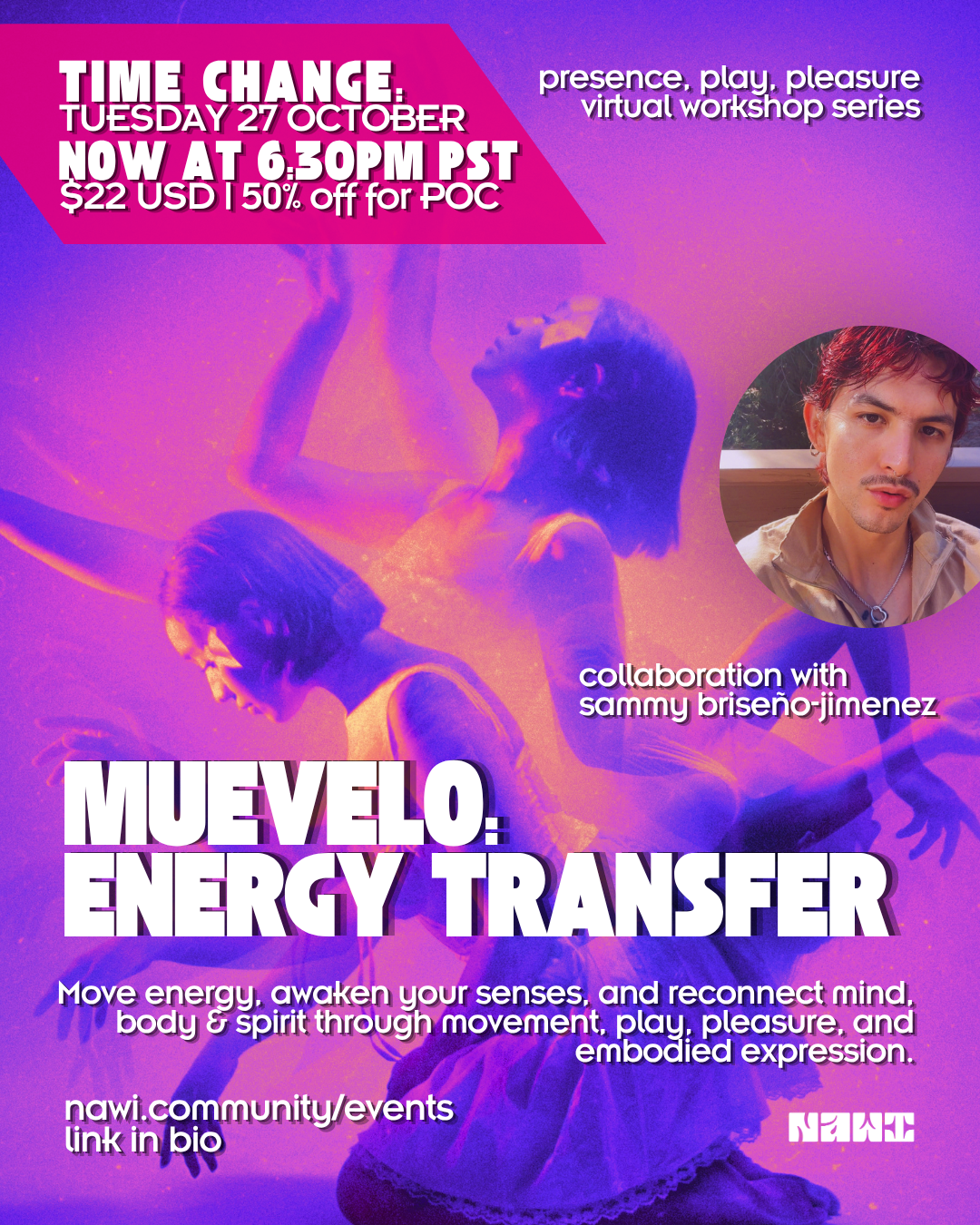
MUEVELO: Energy Transfer
A collaboration between
Sammy Briseno Jimenez × Nawi
Tuesday, October 27th at 6:30pm Pacific Time. Virtual & Recorded.
What becomes possible when movement is no longer about getting the steps right, but about discovering your own rhythm?
MUEVELO invites you to explore movement as a practice of creativity, play, self-expression, and connection. Come as you are, bring your curiosity, and discover what happens when you become the choreographer of your own life.
You don't need dance experience. You only need a willingness to explore.
Move for the joy of it. Move to feel. Move to reconnect.
Discover upcoming Nawi experiences at nawi.community
Further reading
Tomaszewski, C., et al. (2023). Impact of dance therapy on adults with psychological trauma: A systematic review. European Journal of Psychotraumatology. Read the full article.